
.png)
August 18, 2026
Quick answer: The top custom software firms for industrial field service operations are EnterB...
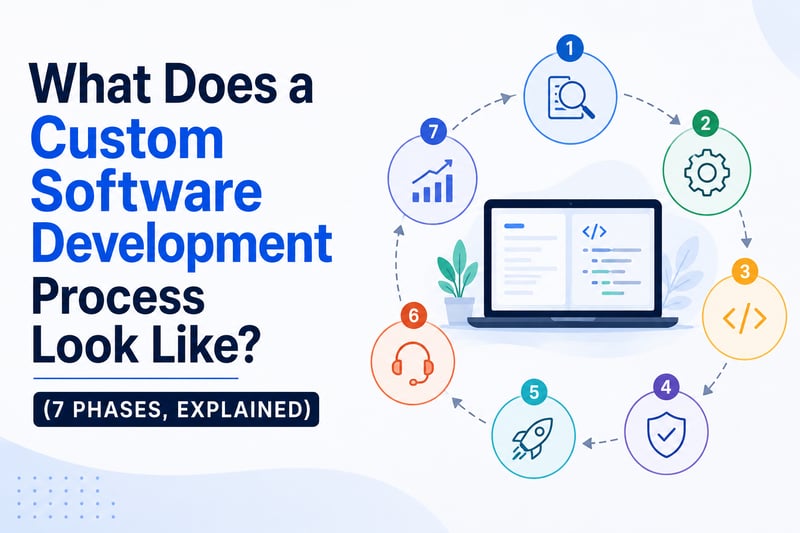
A custom software development process is the structured sequence a development team follows to turn a business problem into working software. Most custom software projects move through seven phases: design and discovery, project initialization and setup, development, user acceptance testing (UAT), go-live, hypercare, and long-term support. The client stays involved through all seven phases, not just the first and the last.
That last sentence is the part most people get wrong, and it's the single biggest reason custom software projects land badly.
| Phase | What it produces |
Typical duration |
Your time commitment |
| Design and Discovery | Requirements, workflows, wireframes, architecture plan, scoped estimate | 2 to 6 weeks | Heavy |
| Project Initialization and Setup | Environments, repos, CI/CD, integrations wired, sprint plan | 1 to 2 weeks | Light |
| Development | Working software delivered in two-week sprints | 1+ months (varies based on size of project, standard is ~2-4 months) | Steady |
| User Acceptance Testing (UAT) | Signed test scripts, defect log, go/no-go decision | 2 to 4 weeks | Heavy |
| Go-Live | Production deployment, migrated data, trained users | 1 to 2 weeks | Moderate |
| HyperCare | Rapid-response fixes, usage monitoring, adoption support | 2 to 6 weeks | Light |
| Long-term Support | Patches, enhancements, roadmap planning | Ongoing | Light |
Durations assume a mid-complexity business application. Small internal tools compress this. Multi-system enterprise platforms stretch it.
Most agencies will tell you their process is agile, show you a diagram with arrows in a circle, and then disappear for four months. You get a demo at the end, it isn't what you pictured, and now everyone's negotiating about scope instead of shipping.
The reality is that the technology stack is rarely why custom software projects fail. Projects fail because the feedback loop between the people building the software and the people who'll actually use it is too slow. Every week without a client touchpoint is a week where a wrong assumption compounds into rework.
So when you're evaluating a custom software development company, the question isn't "what's your process." Everybody has a process. The question is "how often do I see working software, and what happens when I don't like what I see."
In one line: Discovery is where you figure out what to build and, just as importantly, what not to build.
What happens in the discovery phase:
Deliverables: requirements documentation, workflow diagrams, wireframes or prototype, technical architecture plan, phased estimate.
Who you need on your side: an executive sponsor, one day-to-day decision maker (this person matters more than anyone else on the project), and two or three end users who know where the current process actually hurts.
What goes wrong when you skip it: you build features nobody uses. Nearly every project that ran 60% over budget started with a discovery phase that got compressed to save money.
In one line: The setup phase almost nobody writes about, and skipping it is why so many projects lose their first month.
What happens during project initialization:
Deliverables: working environments, populated backlog, sprint schedule, deployment pipeline, RACI or equivalent.
Why it's a separate phase: when initialization gets bundled into development, it quietly eats the first sprint and everyone pretends it didn't. Naming it keeps the timeline honest.
In one line: Working, deployable software every two weeks, with your feedback steering the next sprint.
What happens during the development phase:
Deliverables: working software increments, staging access, sprint demos, updated documentation.
Your role here is the whole point. You're in the sprint demos. You're clicking through staging between demos. When something looks off in sprint three, we change it in sprint four and it costs almost nothing. The same change caught during UAT costs ten times as much, and after go-live it costs more than that.
Development and design aren't fully separate in practice. Detailed design for sprint eight happens around sprint six. We just don't pretend anyone knew everything on day one.
In one line: UAT is where your team, not the development team, decides whether the software does what your business needs.
What happens during user acceptance testing:
Deliverables: completed test scripts, defect log with resolution status, documented go/no-go decision.
What makes UAT actually work: assign specific people to specific scripts with a deadline. UAT that's open to "whoever has time this month" produces no useful signal and delays go-live by weeks. Two focused weeks beat six unfocused ones every time.
One more thing. If UAT is the first time your users have seen the software, the process broke somewhere upstream. Done right, UAT confirms what people already know instead of revealing surprises.
In one line: Launch is a coordinated event with a tested rollback plan, not a deploy button somebody presses on a Friday.
What happens during go-live:
Rollout options: phased by user group or business unit, a pilot with a single team before full release, or a full cutover when running parallel systems isn't realistic. Phased is usually right for anything replacing a daily-use system.
Deliverables: live production software, migrated data, trained users, deployment runbook, monitoring dashboards.
In one line: Hypercare is a short, intense support window right after launch where the engineers who built the system fix issues in hours, not through a ticket queue.
Hypercare is a heightened support period immediately following go-live, typically lasting two to six weeks, in which the original development team stays assigned to the project and responds to issues within hours rather than routing them through standard support.
Here's why it exists. The first two weeks after launch generate more discovery than the previous six months combined, because real users doing real work in a live system surface things no test script anticipated. An edge case in the billing logic that only appears on the first of the month. A report someone needs that never came up because the person who runs it was on leave during discovery.
What happens during hypercare:
Duration: two to six weeks, depending on user count and how business-critical the system is.
Most agencies collapse this into "maintenance" and hand you a ticket portal on launch day. That's the exact moment your users are forming a permanent opinion about whether this software is good, and a 48-hour ticket SLA is how you lose them.
In one line: Software that isn't maintained decays, and support is what protects the investment you already made.
What happens during long-term support:
Typical annual cost: 15% to 20% of the original build cost, varying with complexity and how much active enhancement you want.
Dependencies go end-of-life, browsers change, compliance requirements shift, and your business changes fastest of all. Ongoing support isn't an upsell tacked onto the end of a custom software project. It's the thing that keeps the software worth what you paid for it.
Look, most published software development processes describe a relay race. You hand off requirements, the team runs off with them, and you get the baton back at UAT. It's clean on a diagram and it produces software nobody wanted.
Here's what continuous client involvement looks like across all seven phases:
| Phase | What you're doing |
|---|---|
| Design and Discovery | In the workshops, reacting to wireframes |
| Project Initialization | Approving the backlog and sprint sequence |
| Development | Sprint demo every two weeks, standing staging access |
| User Acceptance Testing | Your people running the tests, not ours |
| Go-Live | Your team makes the go/no-go call |
| HyperCare | Direct access to the engineers who built it |
| Long-Term Support | Quarterly planning, not a ticket queue |
The cost of a change is a function of when you catch it. Catching it in a sprint demo is a conversation. Catching it in UAT is a change request. Catching it after go-live is a project. Continuous involvement is really just a system for catching things early, and everything else about a good development process exists to make that possible.
Ask these five questions in the sales conversation and watch what happens:
| Project type | Timeline | Typical investment |
|---|---|---|
| Simple internal tool | 6 to 12 weeks | Under $75K |
| Mid-complexity business application | 4 to 8 months | $100K to $350K |
| Multi-system enterprise platform | 9 to 18 months | $350K and up |
The three variables that move these numbers most are integration count, compliance requirements, and the number of stakeholder groups who have to agree on decisions. Three integrations and one decision maker is a fundamentally different project than one integration and a steering committee.
Seven phases: design and discovery, project initialization and setup, development, user acceptance testing, go-live, hypercare, and long-term support. Some teams fold initialization into development, and many skip hypercare entirely, which is a mistake.
Small internal tools generally come in under $75K. Mid-complexity business applications run $100K to $350K. Enterprise platforms start around $350K. Budget another 15% to 20% of the build cost annually for support and enhancements. Here at EnterBridge, we often adopt a "Custom SaaS" pricing model, where we bet on the long-term success of a project and charge a small monthly licensing fee for the project instead, alleviating the financial burden and risk that custom software projects often have.
Simple internal tools take 6 to 12 weeks. Mid-complexity business applications run 4 to 8 months. Enterprise platforms with multiple system integrations take 9 to 18 months or more.
Hypercare is a heightened support period immediately after go-live, usually two to six weeks, where the original development team responds to issues within hours rather than through a standard support queue. It exists because live usage surfaces problems that testing can't.
QA testing is done by the development team throughout the build to verify the software works as specified. User acceptance testing is done by the client's own users at the end to verify the software solves the business problem. Both are necessary and neither substitutes for the other.
Heavily during discovery and UAT, steadily during development through sprint demos, lightly during initialization and hypercare. You'll need one named day-to-day decision maker who can commit several hours a week for the length of the project. Projects without that person consistently run long.
In a sprint-based process, changes get evaluated and slotted into an upcoming sprint. Small changes usually absorb into existing scope. Large ones get scoped and estimated as a plan change. What matters is that changes surface in sprint demos rather than at the end.
Sometimes, when the first phase of work is obvious and the rest isn't. What you can't do is skip discovery entirely, because the cost of building the wrong thing dwarfs the cost of a few weeks of planning.
Agile suits most custom software projects because requirements clarify as people see working software. Waterfall still fits work with fixed regulatory specifications and no room for interpretation. Most real projects run agile development inside a phase structure with defined gates, which is what the seven phases above describe.
On a custom build you should own the source code, the infrastructure, and the documentation outright. If a development partner won't give you that, you're renting rather than buying, and you should price the relationship accordingly.
We've built this process around one belief: the client belongs in the room the entire time, not just at the beginning and the end.
That's why our seven phases look the way they do. Discovery is deep enough to produce an estimate we'll stand behind. Initialization is its own named phase so it doesn't quietly eat a sprint. Development happens in two-week increments with a demo you attend and a staging environment you can open any time you're curious. UAT is run by your people, because they're the ones who know whether the software solves the problem. Go-live has a tested rollback plan. And hypercare keeps the engineers who wrote the code on the project through the weeks when it matters most, rather than handing you a ticket portal on launch day and calling it support.
The reality is that we're worth the investment because we deliver faster and with less risk, and both of those come from the same place, which is that you see the software constantly and nothing gets built for four months in the dark.
We also push back. If you bring us a requirement that's going to cost a lot and solve very little, we'll say so before we build it. That's the difference between a development partner and a shop that just takes orders.
Thinking about a custom software project? If you've got something in mind and you want to talk through what these phases would actually look like for your situation, timeline, and budget, we're happy to have that conversation. No pressure, no pitch deck, just a working session on whether the idea holds up and what it would take to build it.

Bo Bleyl is a software engineer at EnterBridge Technologies. He has worked at EnterBridge for 6 years working on projects ranging from mobile app development to web development. Bo is the father of 2 beautiful daughters and enjoys playing sports like basketball and volleyball.

August 18, 2026

July 14, 2026

July 31, 2024