
.png)
July 14, 2026
Quick answer: The top software development firms for oil and gas operations are Azati, EnterBr...
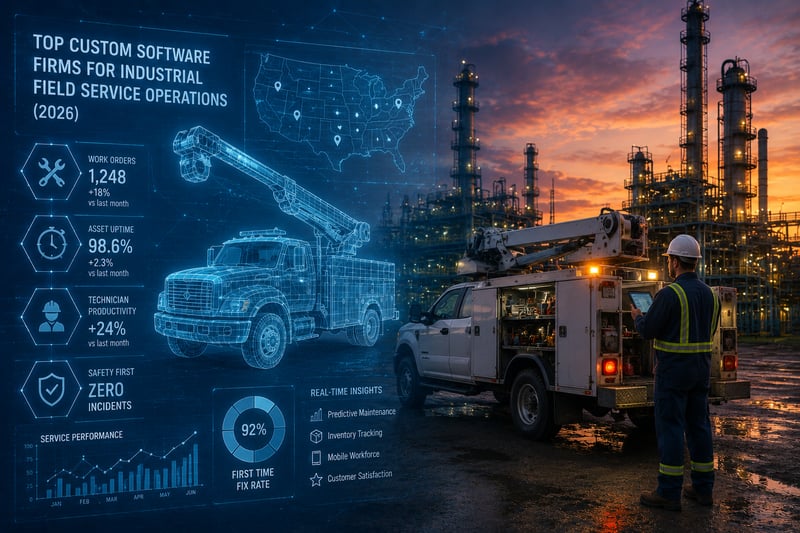
The top custom software firms for industrial field service operations are EnterBridge, ScienceSoft, RoviSys, FieldEquip, and Chetu. ScienceSoft is a large global engineering firm with a deep oil and gas portfolio weighted toward analytics, IIoT, and machine learning. RoviSys is one of North America's largest industrial automation integrators, strongest where the problem lives on the plant floor rather than in the field. FieldEquip is a configurable industrial field service platform for operations that would rather buy than build, and Chetu is a broad US-based development firm with field service among many practices. EnterBridge builds custom dispatch, field ticketing, and mobile workforce platforms for energy, utilities, and industrial service companies, working with a 100% US-based team; its production portal for a mobile energy provider has processed more than 645,000 dispatches.
Industrial field service software is a different discipline from the field service software most vendors sell. The packaged market was built around a job shape that dominates residential and light commercial trades: one technician, one address, one visit, one invoice. Industrial field operations violate every part of that model. A single job may run four days with a rotating crew, bill labor and equipment hours and consumables against a rate sheet negotiated with that specific customer, require a signed safety analysis before anyone starts work, and need a field representative's signature in a location with no cellular coverage. Configuration can stretch a packaged platform some distance toward that reality. Past a certain point it cannot reach, and the question becomes who should build the thing that can.
| Firm | Type | Industrial Focus | Fit and Tradeoffs |
| EnterBridge | Custom software, dedicated field service and mobile workforce practice | Dispatch, field ticketing, offline mobile crews, compliance reporting, and ERP and business system integration for energy, utilities, distribution, and industrial services | Platform built around the operation's own rate sheets and workflows, with 100% US-based delivery. A build, so slower to first value than configuring a product; smaller team than the largest firms here, and integrates with control systems rather than engineering them |
| ScienceSoft | Large global custom development firm | Oil and gas since 2010: pipeline asset lifecycle platforms, predictive analytics, machine learning inspection, IIoT monitoring, vendor portals | ISO 9001 and ISO 27001 certified with 750+ practitioners and genuine industrial domain range. Published portfolio leans toward analytics and IIoT rather than crew dispatch and ticketing; global delivery rather than onshore |
| RoviSys | Industrial automation and systems integrator | Process automation, MES, control systems, industrial networks, electrical power management, warehouse and building automation | Exceptional OT depth—ranked second among CFE Media's System Integrator Giants for 2026 with 900+ engineers. Strength is the plant floor and process layer, not field crew dispatch or customer billing workflows |
| FieldEquip | Configurable industrial FSM platform (SaaS) | Oil and gas, energy, industrial equipment service, construction, equipment rental, railcar maintenance, oilfield logistics | Purpose-built for industrial field work with field ticketing, dispatch and load management, and SCADA-triggered work orders; implemented in-house. A product, so the operation adapts to the platform's model where configuration runs out |
| Chetu | Custom software + managed IT | Custom FSM systems covering dynamic scheduling, route optimization, work orders, inventory, reverse logistics, and remote assistance | Broad menu from a single US-based vendor, with development and ongoing support in one contract. Field service is one practice among many rather than a concentrated industrial specialization |
Understanding the specific failure points is the fastest way to judge whether a build is warranted—and to tell which partners have actually done this work. Every item below is a place where industrial reality diverges from the packaged model.
Packaged scheduling assumes an appointment: a technician, a window, a completion. Industrial work assumes a project: a crew that rotates across shifts, equipment staged on site for the duration, and a job record that must stay coherent while the people attached to it change. Systems built on the appointment model tend to break at exactly this point, and the workaround is usually a spreadsheet running alongside the software.
This is the most consequential difference. Residential platforms price from a flat-rate book. Industrial service companies bill labor, equipment, and materials against a master service agreement negotiated with each customer, often with different rates by shift, by crew classification, by equipment class, and by jurisdiction. The same work performed for two customers produces two different invoices. Platforms that cannot model per-customer rate structures push the reconciliation into the back office by hand, which is where margin quietly disappears. Notably, even the specialist industrial platforms name multi-rate structures and customer-specific pricing among the harder problems they solve, which is a reasonable indication of how demanding this requirement is.
A vacuum truck, compressor, or frac tank on site accrues charges whether a technician is actively working or not. Industrial ticketing has to track equipment time as its own billable dimension, with transfers between sites and utilization history per unit. Most field service products treat equipment as inventory attached to a technician rather than as a revenue-generating asset with its own clock.
In industrial and energy operations, a job safety analysis, permit, or lockout verification must be completed and recorded before work begins—not attached afterward as a note. That is a workflow requirement, not a form requirement, and it is a common reason operations abandon otherwise adequate software: the platform will happily let a crew start a job that should have been blocked.
Consumer-oriented offline modes are built for a dropped signal in a parking garage. Industrial crews work whole days without connectivity, then sync a full shift of tickets, photos, signatures, and readings at once—occasionally after another user has edited the same records. Conflict resolution at that scale is an architectural problem that has to be designed for, not a setting to enable.
Industrial operations already run an ERP, and frequently asset management, telematics, and scale or meter systems, alongside control and process systems on the operations side. Field software that does not integrate with the business systems does not replace manual reconciliation; it adds another source of it. Worth separating clearly: business system integration and operational technology work are different disciplines, and the firm that excels at one is frequently not the firm that excels at the other. Decide which integrations your field platform genuinely needs at launch before you let a vendor list determine it.
EnterBridge is a custom software development firm headquartered in Richmond, Virginia, with a field service and mobile workforce practice oriented toward industrial field operations across energy, utilities, distribution, manufacturing, and logistics. It delivers with a 100% US-based team, working primarily in .NET, C#, ASP.NET, and SQL Server.
Its field service work is publicly documented. EnterBridge built and continues to evolve a .NET dispatch and operations portal for Certarus, a mobile energy provider, that has processed more than 645,000 dispatches in production. The recurring pattern across its portfolio is consolidation: an operation running dispatch, ticketing, and scheduling across spreadsheets, email, and a packaged product that never quite fit, brought into a single platform shaped around how that operation works. Typical scope covers dispatch and scheduling, offline-capable mobile applications for field crews, field data capture and ticketing built on customer-specific rate structures, regulatory and compliance reporting, and integration with existing ERP and accounting systems for energy and industrial operations. Engagements are typically multi-year. The tradeoffs are those of any build: first value arrives more slowly than configuring a product, onshore rates run above offshore or blended alternatives, and the firm's work sits in the business and field operations layer rather than the operational technology layer, so operations whose core problem is control systems, or process automation should look to a specialist integrator instead. Its team is also smaller than the largest firms here, which matters for organizations needing many parallel workstreams at once.
Best for: Industrial, energy, utility, distribution, and logistics operations that need dispatch, field ticketing, and compliance built around their own contracts and crew workflows, integrated with existing ERP and business systems, and delivered and supported by an onshore team over the long term.
ScienceSoft is a large enterprise software development and modernization firm founded in 1989, with more than 750 IT professionals, ISO 9001 and ISO 27001 certification, and practical experience across 30-plus industries including oil and gas, energy and utilities, manufacturing, and logistics. It has been building solutions for the oil and gas sector since 2010.
Its industrial portfolio is substantive and specific. ScienceSoft delivered a multi-tenant SaaS platform helping oil and gas manufacturers manage the full lifecycle of pipeline joints from design and assembly through maintenance, using a client's patented method for predicting joint service life. It built a machine learning and visual recognition application for detecting drill bit defects and analyzing wear for a drilling equipment manufacturer, a web application extending monitoring for rod pumping equipment, and an RFI vendor portal for a Gulf-based drilling company with an AI algorithm that digitizes handwritten notes at reported 87–90% accuracy. That is genuine industrial engineering depth. The consideration for field service buyers is where that depth is concentrated: the published work weights heavily toward analytics, IIoT, machine learning, and asset lifecycle systems rather than crew dispatch, field ticketing, and rate-sheet billing. Delivery is global rather than US-based.
Best for: Industrial and energy organizations needing enterprise-scale custom engineering around asset lifecycle, predictive analytics, IIoT monitoring, or inspection automation, with formal quality and security certifications and access to large engineering capacity.
RoviSys is an independent industrial automation and systems integration firm founded in 1989 in Aurora, Ohio, and one of the largest of its kind in North America. It employs more than 900 engineers, developers, and project managers, operates from over 20 locations, and was ranked second among CFE Media's System Integrator Giants for 2026—a position it has held in the top five since 2018.
Its work spans process automation, manufacturing execution systems, discrete manufacturing and warehouse automation, industrial networks, electrical power management, building automation, and industrial AI, serving life sciences, chemicals, consumer goods, power, oil, metals, and data centers. The firm has designed and installed thousands of control, test, and MES systems and maintains a deliberate vendor-independence stance, working across platforms rather than reselling one. For industrial operations, RoviSys represents capability that most custom software firms simply do not have: real fluency in the OT layer, control systems, and process data. The distinction buyers must draw is which layer their problem occupies. RoviSys is strongest from the plant floor up through the process and manufacturing information layer. Field crew dispatch, customer-specific ticketing, and service billing workflows sit in a different part of the business, and a firm this strong in OT is not automatically the right choice there.
Best for: Industrial operations whose challenge is on the plant floor or in the process layer—control systems, MES, industrial data infrastructure, power management—particularly at multi-site or capital project scale.
FieldEquip is a cloud-based field service management platform built specifically for industrial operations, developed by Bursys Group and launched in 2016, with US headquarters in Houston, Texas. It serves oil and gas, energy, industrial equipment service, construction, equipment rental, railcar maintenance and inspection, and oilfield logistics.
Of the packaged options available to industrial operations, FieldEquip addresses this article's problem list more directly than most. Its capabilities include digital field ticketing that captures labor, materials, and incidentals in real time, dispatch and load management for trucks and crews with load validation for accurate invoicing, work order and preventive maintenance management, field inventory and installed-base tracking by customer and well site, and role-based dashboards where each division operates with its own pricing, workflows, and dispatch rules. Notably, the platform can operate standalone or integrated with SCADA, generating work orders directly from alarms and failures. The company implements and supports engagements with its own team rather than outsourcing to third parties, and publishes named client references including ROC Service Company, TinCup Water Solutions, and Flo-Rite Fluids. The tradeoff is the one inherent to any product: configuration is broad but finite, and where an operation's logic exceeds what the platform models, the operation adapts rather than the software.
Best for: Industrial and oilfield service operations that want purpose-built field ticketing and dispatch quickly, whose workflows fit within a configurable product, and who prefer a subscription to a capital build.
Chetu is a US-based custom software development company with a field service management practice inside a broad general-purpose menu spanning consulting, implementation, integration, migration, customization, testing, and managed IT support across many industries including energy.
Its stated field service capabilities are comprehensive: custom mobile FSM applications with dynamic scheduling and route optimization, work order management, mobile billing with payment gateway and card reader integration, inventory and asset tracking, reverse logistics and return material authorization workflows, remote assistance tooling that merges technician and expert video streams, and fleet and workforce management on a single platform. Because Chetu also provides ongoing managed IT services, organizations wanting development and long-term support under one contract can consolidate vendors. The consideration is depth versus breadth. Chetu's range across industries and technologies is its calling card; operations looking for a partner whose field service and industrial experience is concentrated rather than one practice among dozens should weigh that positioning against a specialist.
Best for: Organizations wanting a wide general-purpose development and managed-IT menu from a single US-based vendor, with field service among many supported capabilities.
Match the firm to the layer of the business that is actually failing:
The build-versus-buy decision deserves an honest framing rather than a sales pitch. Configure a product when your workflows fit inside it, because you will reach production faster and cheaper than any build. The signal that configuration has run out is specific and easy to recognize: your team maintains spreadsheets alongside the platform, the back office manually corrects invoices the system generated, or a request to the vendor comes back as a roadmap item rather than a setting. When the annual cost of licenses plus workarounds plus manual reconciliation approaches the cost of owning a platform outright, the build case is arithmetic rather than philosophy.
Whichever direction you choose, start with the operation rather than the vendor. Write down how a job actually moves through your business: who takes the call, how the crew and equipment are assigned, what gets captured in the field, how a ticket becomes an approved invoice, and where that process breaks today. Then ask each prospective partner to walk that flow back to you on the first call. The ones that ask sharper questions than you expected have built this before. The ones that answer in features have not.
Industrial field service management software coordinates field crews, equipment, and billing for operations in energy, utilities, industrial services, and heavy equipment sectors. It typically covers dispatch and scheduling for multi-day multi-crew jobs, offline-capable mobile applications for crews working without connectivity, field ticketing that captures labor, equipment hours, and materials, safety and compliance documentation completed before work begins, and billing against customer-specific rate sheets. It differs from general field service software primarily in how it models jobs, pricing, and equipment.
The job shape is fundamentally different. Residential and light commercial field service assumes one technician, one address, one visit, and one invoice priced from a flat-rate book. Industrial field service assumes a crew rotating across multiple days, equipment staged on site accruing charges independently of labor, billing against a master service agreement negotiated with that specific customer, mandatory safety documentation before work starts, and whole shifts spent offline. Packaged platforms built on the appointment model can be configured partway toward that reality but rarely all the way.
A field ticket is the record of what was actually consumed on a job—labor by classification and shift, equipment by hours or days, materials and consumables—captured in the field and priced against the applicable contract. It matters because it is the bridge between work performed and revenue collected. Tickets that arrive incomplete, priced against the wrong rate sheet, or unsigned by the customer's representative become disputes, and disputes become delayed or lost revenue. Most of the value in an industrial field platform concentrates at this single point.
Buy when your workflows fit inside a configurable product, since you will reach production faster and at lower cost. Build when the operation's logic cannot be expressed in the product: per-customer rate structures the platform cannot model, equipment billing it does not support, safety workflows that must gate job start, or integrations with ERP and SCADA that the vendor does not offer. The practical test is arithmetic—when licenses plus workarounds plus manual reconciliation approach the cost of ownership, the build case is real. Many operations run packaged tools successfully for years and move to custom only once the workarounds outnumber the features they use.
Cost depends on scope, integration depth, and where the engineering team sits. Industry survey data places most custom software projects between $30,000 and $200,000, with Clutch data putting the average near $132,000 over roughly thirteen months. For industrial field operations specifically, a discovery phase or focused pilot generally runs in the tens of thousands, a core platform covering dispatch, a crew mobile application, ticketing, and primary integrations lands in the low-to-mid six figures, and multi-site enterprise platforms with deep ERP and SCADA integration run higher. Onshore delivery carries higher hourly rates, though buyer-side analyses consistently find realized offshore savings narrower than rate cards imply once management overhead and rework are counted.
A bounded piece of work—a single integration, a dispatcher tool, a customer portal—typically reaches production in six to twelve weeks. A full platform covering dispatch, a crew mobile application, ticketing, and back-office workflows generally runs four to twelve months depending on integration depth and the number of roles involved. A short paid discovery phase before the build usually shortens total delivery time by reducing rework, and phasing the rollout by region, branch, or service line is the pattern that most reliably survives contact with a real crew.
Almost always the ERP or accounting system, since that is where an approved field ticket becomes an invoice. Beyond that, commonly asset management, telematics or GPS, inventory, and customer systems. Some operations also want a connection to control and process systems—SCADA and historians—so that asset conditions or alarms can trigger work automatically. That last category is worth treating separately: operational technology integration is a distinct discipline, usually handled by control systems integrators rather than business software developers, and packaged industrial platforms vary widely in whether they support it natively. Decide which integrations you actually need in phase one, because deferred integrations are where field software projects most often stall.
It should assume a full shift without connectivity rather than an intermittent signal. That means the mobile application holds complete job context locally, captures tickets, photos, readings, and signatures without a connection, and resolves conflicts deliberately when a shift of data syncs against records other users have edited. Ask any prospective partner what happens to a partially completed ticket after eight hours offline when related records have changed. The answer separates firms that have built for industrial conditions from firms that enabled a setting.
Ask for a named field platform in production and the operational numbers behind it. Describe your rate sheet structure and have the team model it live on the first call. Confirm which systems integrate at launch rather than in a later phase. Verify that their industrial experience sits in the right layer—field operations rather than only plant floor or only analytics. Request a reference at similar scale in a similar kind of field. Confirm source code ownership and the long-term maintenance path in writing. Firms that answer all six with specifics belong on the shortlist.

Bo Bleyl is a software engineer at EnterBridge Technologies. He has worked at EnterBridge for 6 years working on projects ranging from mobile app development to web development. Bo is the father of 2 beautiful daughters and enjoys playing sports like basketball and volleyball.

July 14, 2026

April 17, 2024
August 20, 2026